SHRI SHIVAJI SCIENCE COLLEGE, AMRAVATI
DBT STAR COLLEGE PROJECT ACTIVITY
ACTIVITY REPORT
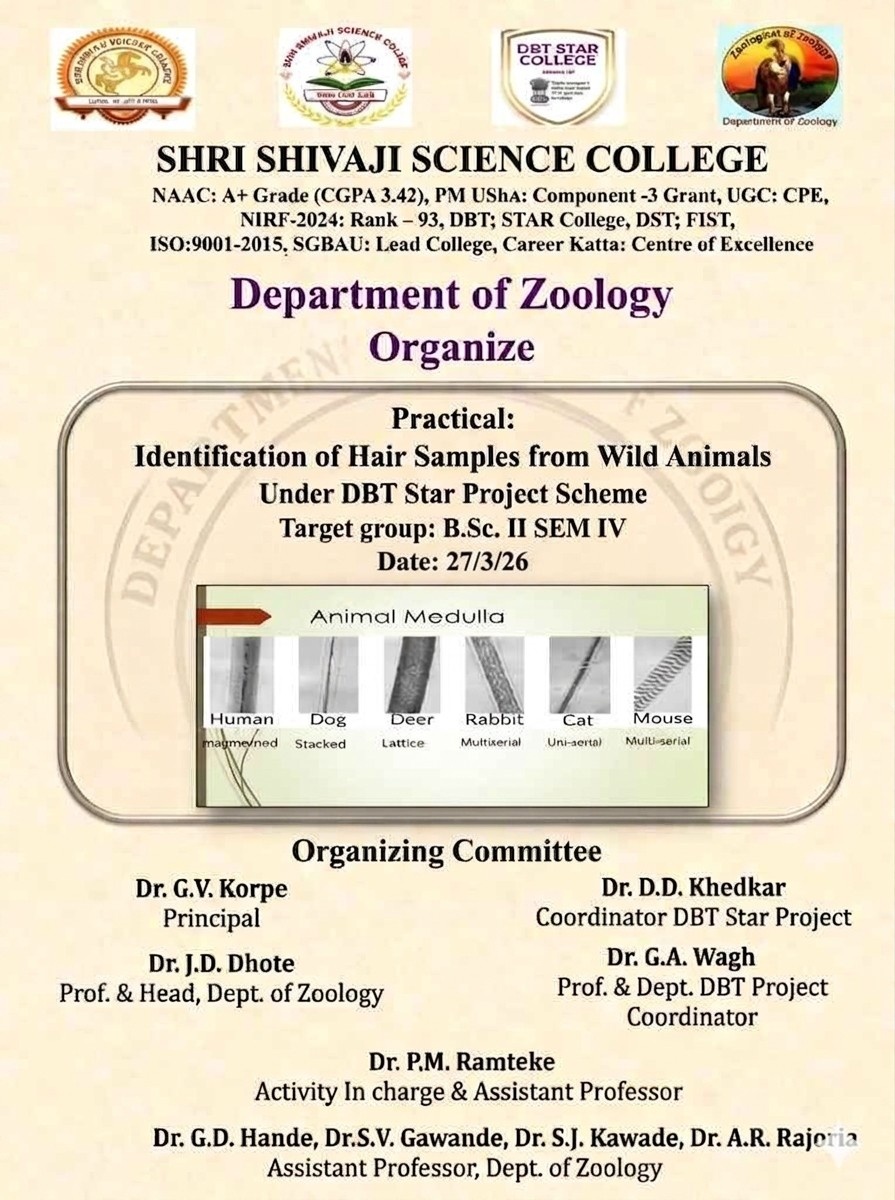
Identification of Hair Samples from Wild Animals
Activity Dates: 27 th March 2026
Type of Activity: Practical
Organizing Department: Department of Zoology
Program Coordinators: Dr. G. A. Wagh, Dr. P.M. Ramteke
Head of the Department: Dr. J. D. Dhote
External Collaborator (if any): -
Objectives:
- To study the morphological structure of mammalian hair under a microscope.
- To identify and differentiate the cuticle, cortex, and medulla of hair.
- To analyze the medullary patterns for species identification.
- To understand the importance of guard hair in Tricho-taxonomy.
- To understand the application of hair analysis in wildlife forensics and conservation.
No of Beneficieries: 50
Classes Involved: B.Sc. II Students
Venue of the Activity: Zoology Departmental Lab
Activity Report:
The study of mammalian hair plays a crucial role in wildlife biology, taxonomy, and forensic science. Hair, being a unique characteristic of mammals, provides significant information for species identification, especially when other morphological features are absent. The scientific study of hair structure for taxonomic purposes is known as Tricho-taxonomy. This method has gained importance in wildlife forensic investigations, ecological studies, and biodiversity conservation.
Mammalian hair is an exoskeletal structure consisting of three main layers: cuticle, cortex, and medulla. Each of these layers exhibits species-specific characteristics. Among these, the medulla—the central core of the hair—provides the most diagnostic features for species identification. The variation in medullary patterns such as ladder, lattice, simple, and aeriform structures, enables researchers to differentiate between species.
Hair types in mammals include guard hair, under hair, vibrissae, bristles, and spines. Among these, guard hairs are most significant for identification because they are coarse, long, and structurally distinct. Guard hairs are usually collected from the dorsal region of animals, as they provide consistent and reliable features.
Tricho-taxonomic analysis is widely used in studying predator diets through scat analysis, controlling illegal wildlife trade, and identifying confiscated animal products such as skins, fur, and leather goods. In India, where wildlife crimes are a major concern, this technique serves as an effective and economical tool for species identification.
The present practical focuses on the microscopic examination of mammalian hair to understand its structure and identify species based on characteristic features. It also aims to develop a reference understanding of hair morphology for academic and research purposes.
Materials Required
• Hair samples of different mammals
• Glass slides and cover slips
• Distilled water
• 70% alcohol
• Xylene
• DPX mounting medium
• Needle/forceps
• Microscope (compound microscope)
• Blotting paper
Methodology
1. Collection of Samples
Hair samples were collected from different mammals, preferably from the dorsal region. Care was taken to collect intact hairs with roots.
2. Cleaning of Hair
The collected hair samples were washed thoroughly in distilled water to remove dust and debris. They were then cleaned using 70% alcohol to remove oils and impurities.
3. Slide Preparation
Cleaned hair samples were placed on a glass slide. A drop of DPX mounting medium was added, and a cover slip was gently placed over the sample to avoid air bubbles. Thick hairs were sometimes treated with xylene to improve transparency.
4. Microscopic Observation
Prepared slides were observed under a compound microscope using low and high magnifications. The following features were carefully studied:
• Hair shaft structure
• Medullary pattern
• Cortex thickness
• Presence of pigmentation
• Shape and arrangement of cells
5. Recording Observations
Observations were recorded based on:
• Type of medulla (continuous, interrupted, lattice, ladder, etc.)
• Margin of medulla (smooth, scalloped, fringed)
• Colour pattern (unicoloured or banded)
• Structural variations in proximal, medial, and distal regions
Observations
The hair samples showed significant variation in structure and pattern among different species. Key observations include:
1. Medullary Structure
o Some species exhibited continuous medulla, while others showed fragmented or interrupted patterns.
o Ladder and lattice patterns were common in herbivorous mammals, whereas carnivores often showed simple or irregular medulla.
2. Cortex Thickness
o The cortex varied in thickness among species. In some animals, it was thicker than the medulla, while in others it was thin.
3. Hair Colouration
o Hair samples were either unicolored or banded (bicoloured/multicoloured).
o Banded hair showed distinct pigment distribution, aiding identification.
4. Medullary Margins
o Margins were observed as smooth, scalloped, or fringed depending on the species.
5. Regional Variation in Hair
o The proximal, medial, and distal regions of the hair showed structural variation, especially in the medullary pattern.
Analysis of hair remains recovered from carnivore scats provides a powerful tool in wildlife forensics and conservation biology. The identification of wild boar (Sus scrofa) hair in Bengal Tiger scat confirms prey selection patterns and helps in understanding trophic relationships within forest ecosystems. Similarly, the presence of unidentified hair samples in Indian Leopard scat highlights the need for advanced forensic techniques such as microscopic hair analysis, medullary pattern examination, and DNA barcoding to accurately determine prey species. The detection of Sambar Deer hair further contributes to assessing predator diet composition and prey availability.
From a forensic perspective, such analyses assist in species identification, verification of predator presence, and investigation of human–wildlife conflict cases, including livestock predation or poaching incidents. In wildlife conservation, scat-based hair analysis is a non-invasive method that aids in biodiversity monitoring, population assessment, and habitat management planning. It helps researchers evaluate predator-prey dynamics, ecological balance, and the health of ecosystems without disturbing animals. Overall, integrating hair identification techniques into wildlife studies strengthens conservation strategies and supports evidence-based decision-making for the protection of endangered and keystone species.
Results and Discussion
The study demonstrated that hair morphology is highly useful in identifying mammalian species. The medulla, being the most distinct component, provided reliable diagnostic characters. The variation in medullary patterns, such as ladder, lattice, and simple structures, helped classify the hair samples.
Herbivorous animals like deer and cattle generally showed a lattice-type medulla, whereas carnivorous animals like cats and dogs exhibited a simple or irregular medulla. Rodents and primates showed unique medullary arrangements, making them distinguishable from other groups.
The study also highlighted the importance of examining different regions of hair (proximal, medial, distal), as the medullary pattern may vary along the length of the hair. This variation increases the accuracy of identification.
Trichotaxonomy proves especially useful in wildlife forensic science, where only small fragments of hair or skin are available. It helps enforcement agencies identify species involved in illegal trade and poaching activities. Moreover, it is also useful in ecological studies such as predator-prey relationships. However, limitations include the requirement of expertise in microscopic analysis and the possibility of variation within the same species. Therefore, combining trichotaxonomy with molecular techniques can enhance accuracy.
In conclusion, the practical on microscopic identification of mammalian hair proved to be an effective educational tool that integrated theoretical knowledge with practical application. It highlighted the importance of hair morphology as a simple, economical, and reliable method for species identification. The study reinforced the role of trichotaxonomy in ecological research, forensic science, and conservation biology. By equipping students with essential skills and knowledge, the activity contributed to their academic development and prepared them for future research in wildlife science and environmental studies.
Outcomes:
- Students gained knowledge about the structural organization of mammalian hair.
- They developed skills in microscopic techniques and slide preparation.
- Students learned to identify species based on hair morphology.
- They understood the importance of tricho-taxonomy in wildlife forensics.
- Students became aware of the role of such studies in biodiversity conservation and wildlife protection.
Photos:
 Hands-on learning in the Zoology Lab. Students meticulously prepare slides for the Microscopic Identification of Hair Samples from Wild Animals, bridging the gap between field collection and laboratory analysis. |  Precision in practice. Using high-powered microscopes, students examine the medullary patterns and cuticular scales of various wild animal hairs to determine species-specific characteristics. |
 "Collaboration at the lens. Students work together to identify unique microscopic markers, a critical step in wildlife forensics and ecological research." |  From theory to observation. A structured laboratory session where students learn the morphological diversity of mammalian hair before engaging in practical identification. |
 Species Identification via Trichology: Using compound microscopy to examine the structural characteristics of wild animal hair, a key technique in biodiversity studies and wildlife conservation research. |
Attendance Sheet:
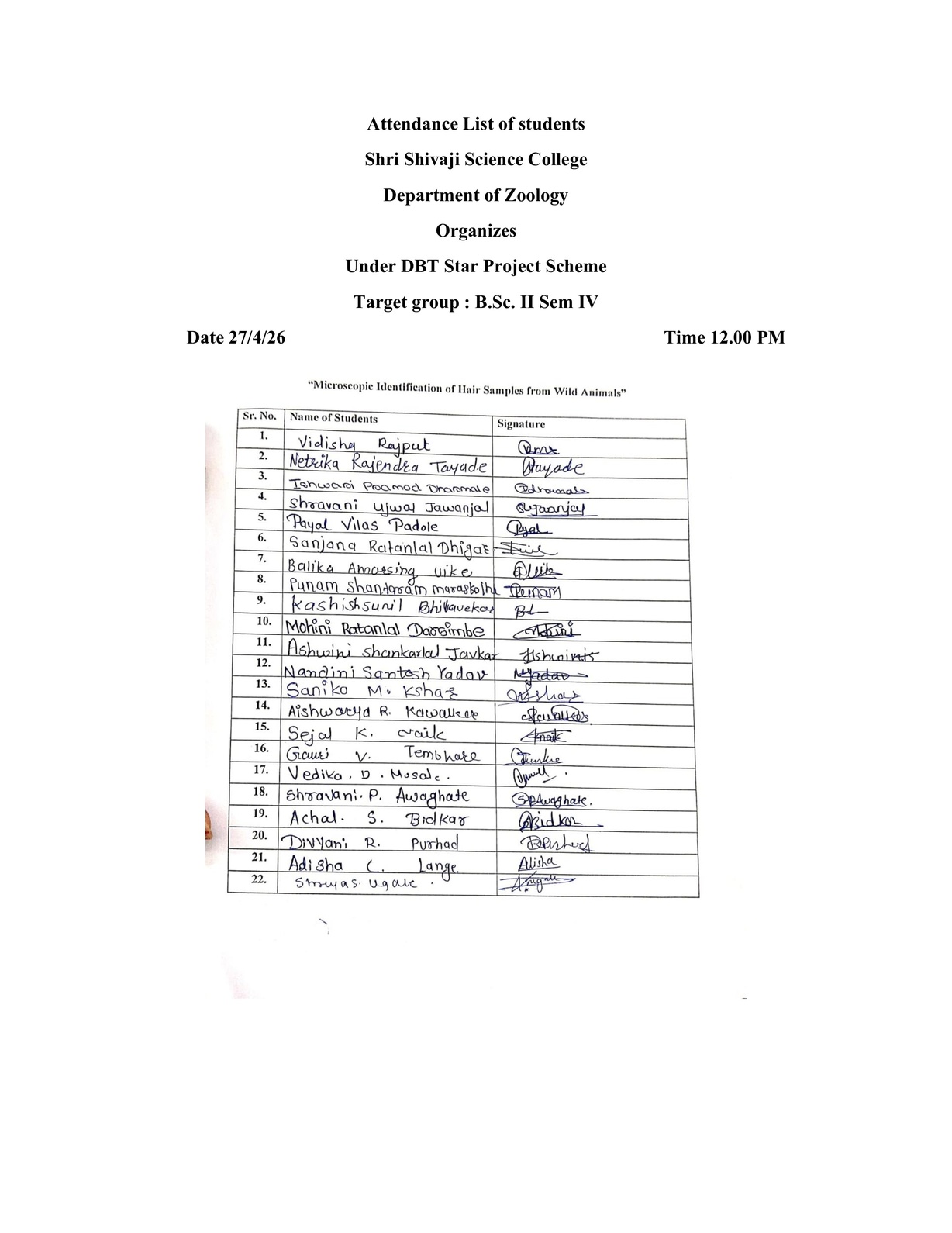 Sheet |
 Sheet |