SHRI SHIVAJI SCIENCE COLLEGE, AMRAVATI
DBT STAR COLLEGE PROJECT ACTIVITY
ACTIVITY REPORT

Assessment of Carbon Sequestration and Carbon Footprints at parking area of Shri Shivaji Science College, Amravati
Activity Dates: Nov and Dec 2025
Type of Activity: Minor Research Project
Organizing Department: Department of Environmental Science
Program Coordinators: Mr. V. D. Bute
Head of the Department: Dr. S. P. Ingole
External Collaborator (if any): No
Objectives:
- To evaluate the carbon footprint generated by vehicles in the parking area of Shri Shivaji Science College.
- To study the carbon sequestration potential of trees and vegetation available in the parking premises.
- To identify and list the different tree species present in and around the parking zone.
- To record tree measurements such as girth, height, and canopy spread for estimating biomass and carbon storage.
- To determine the total carbon stock stored by the trees in the parking area.
No of Beneficieries: 01
Classes Involved: B.Sc. II Major Env. Sci.
Venue of the Activity: Shri Shivaji Science College, Amravati
Activity Report:
INTRODUCTION
Climate change is regarded as one of the most serious environmental concerns in the present era. Rapid urbanization, population growth, industrial progress, expansion of transportation, and excessive dependence on fossil fuels have caused a continuous increase in greenhouse gases such as carbon dioxide (CO₂), methane (CH₄), and nitrous oxide (N₂O) in the atmosphere. Among these gases, carbon dioxide is the chief factor responsible for global warming. Rising atmospheric CO₂ levels lead to higher temperatures, irregular rainfall, heat waves, loss of biodiversity, and several environmental disturbances. Therefore, it has become necessary to implement suitable measures to reduce carbon emissions and preserve environmental balance.
One of the most efficient natural ways to lower atmospheric carbon dioxide is carbon sequestration. Carbon sequestration is the process by which carbon dioxide is absorbed and stored in trees, plants, soil, and other natural reservoirs for a long duration. Through photosynthesis, plants utilize atmospheric CO₂ and convert it into biomass such as roots, trunks, stems, branches, and leaves. In urban regions, trees and green spaces are highly beneficial in minimizing pollution and improving air quality. Thus, assessment of the carbon sequestration capacity of vegetation is essential for environmental protection and climate change mitigation.
Another important term associated with environmental studies is the carbon footprint. Carbon footprint means the total quantity of greenhouse gases released directly or indirectly due to various human activities. It is generally measured as carbon dioxide equivalent (CO₂e). Major contributors to carbon emissions include transportation, electricity usage, burning of fuels, construction activities, and waste generation. Parking areas are often recognized as emission hotspots because of regular vehicle movement, engine starting, and idling.
STUDY AREA
The present study was conducted in the area surrounding the parking zone of Shri Shivaji Science College, Amravati, Maharashtra.This area includes parking spaces,internal roads, adjacent open land and surrounding green patches with planted and naturally growing trees.The selected site represents a mix of vehicular activity and vegetation,making it suitable for assessing both carbon sequestration potential and carbon emissions associated with transportation related activities.
METHODOLOGY
For calculation of Carbon Sequestration following steps are follow:
1. Determine the Total (green) Weight of the Tree
2. Determine the Dry Weight of the Tree
3. Determine the weight of Carbon in the Tree
4. Determine the weight of Carbon Dioxide sequestrated in the Tree
5. Determine the weight of Carbon Dioxide sequestrated in the Tree per year
1. Determine the Total Green Weight of the Tree
Based on tree species in the Southeast United States, the algorithm to calculate the weight of tree is:
W = Above ground weight of tree in pound D = Diameter of the Trunk in Inches
H = Height of the Tree in Feets
For Trees with D < 11 : W = 0.25D ^ 2 * H
For Trees with D >= 11 W = 0.15D ^ 2
Depending upon the species, the coefficient could change, and the variable D ^ 2 and H could be raised to exponents just above or below
1. However, these two equations could be seen as an "average" of all the species' equation.The root system weights about 20% as much as the above ground weight of tree. Therefore, to determine the Total green Weight of the Tree, multiply the above ground weight of tree by 120%.
2. Determine the Dry Weight of the Tree
This is based on an extension publication from the University of Nebraska. This publication has a table with average weight for one cord of wood for different temperate tree species. Taking all species in the table into account, the average tree is 72.5% dry matter and 27.5% moisture.
Therefore,to determine the Dry Weight of the Tree, multiply the weight of tree by 72.5%.
3. Determine the weight of Carbon in the Tree
The average Carbon content is generally 50% of the tree's total volume. Therefore, to determine the weight of Carbon in the Tree, multiply the dry weight of tree by 50%.
4. Determine the weight of Carbon Dioxide sequestrated in the Tree
Carbon Dioxide is composed of one molecule of Carbon and 2 molecule of Oxygen. The atomic weight of Carbon is 12.001115
The atomic weight of Oxygen is 15.9994
The weight of Carbon Dioxide is C +20= 43.999915.
The ratio of Carbon Dioxide to C is 43.999915/12.001115=3.6663
Therefore,to determine the weight of Carbon Dioxide sequestrated in the Tree, multiply the weight of Carbon in the Tree by 3.6663.
5. Determine the weight of Carbon Dioxide sequestrated in the Tree per year
Divide the weight of Carbon Dioxide sequestrated in the Tree by age of the Tree.Et voila! Example:-
Height of the Tree= 4.81 m
Gridth=11.811 cm
So, Above Ground Weight = 0.25 D2H
= 0.25× (11.811)²x 15.78
= 0.25 x 139.49 x 15.78
= 0.25x2201.1522 = 550.28 Lbs
Total Green weight(including roots)= above ground weight x 120%
= 550.28 x 120%
= 660.33 Lbs
Dry Weight = Total green Weight x 72.5%
= 660.33x72.5% = 478.73 Lbs
So, Carbon content in tree = dry weight x 50%
= 478.73x50%
= 239.36 Lbs
Therefore,
Carbon Dioxide sequestrated in the Tree = weight of Carbon content x 3.6663
= 239.36 x 3.6663
= 877.56 Lbs
Carbon Dioxide sequestrated in the Tree per year = 877.56 +10
= 87.756 Lbs (39.805 kg)
That area has 18 Teek (Tectona grandis) planted.
So, CO2 Sequestered by that area = 87.756 lbs x 18 trees
= 1579.608 lbs
OBSERVATION
During the field survey carried out in the parking area of Shri Shivaji Science College, teak (Tectona grandis) was identified as one of the major tree species present in the study site. These trees contribute considerably to the green cover of the campus and help in maintaining ecological balance. The trees around the parking zone provide shade, reduce surrounding temperature, control dust, and improve the visual appearance of the area. Tree biomass measurements were recorded and used for estimating carbon storage by applying standard scientific methods and accepted conversion factors.
The selected teak tree was found to have a dry biomass of 478.73 lbs. Dry biomass refers to the total organic matter of the tree after excluding moisture content and is an important factor in carbon estimation. It is generally considered that nearly 50% of dry biomass is carbon content. Based on this assumption, the selected teak tree was estimated to contain 239.36 lbs of carbon in its biomass. This shows that the tree functions as a natural carbon sink by absorbing atmospheric carbon dioxide through photosynthesis and storing it in roots, stem, branches, and leaves.
Further calculations were performed using the standard carbon to carbon dioxide conversion factor of 3.6663. The results indicated that the selected teak tree has a total carbon dioxide sequestration potential of 877.56 lbs over a period of 10 years. This reflects the long-term importance of trees in lowering atmospheric carbon dioxide levels and helping to reduce climate change impacts.
RESULT
The results of the present investigation clearly demonstrate that the green cover in the parking area of Shri Shivaji Science College plays a significant role in carbon sequestration and environmental protection. Trees growing within the campus act as natural carbon reservoirs by absorbing atmospheric carbon dioxide through photosynthesis and storing it as biomass. Among the species recorded during the survey, teak (Tectona grandis) was observed to be one of the major contributors to carbon storage.
Based on biomass calculations, a single mature teak tree was estimated to sequester about 877.56 lbs of carbon dioxide over a period of 10 years. This indicates that even one healthy tree can make a meaningful contribution toward reducing atmospheric carbon dioxide levels. The average annual sequestration rate of the selected teak tree was determined to be 87.756 lbs of carbon dioxide per year, showing the continuous capacity of trees to remove carbon from the atmosphere.
The survey also revealed that the parking area contains 18 trees, which collectively absorb around 72.393 kg of carbon dioxide every year. This total sequestration capacity emphasizes the ecological importance of maintaining trees in areas regularly affected by vehicular movement. Since parking zones are commonly associated with emissions from two-wheelers, cars, and other vehicles, the presence of trees helps in partially compensating for the carbon footprint generated by transportation activities.
Apart from carbon storage, the trees in the parking area were found to provide several additional environmental advantages. Areas under tree shade remained cooler than open paved surfaces, indicating their role in reducing surface temperature and improving the local microclimate. Trees also help in controlling dust pollution, lowering noise levels, and improving the scenic beauty of the campus.
The findings further confirm that conservation and proper maintenance of existing vegetation are essential for sustainable campus development. Older trees with larger girth and wider canopy were observed to contain higher biomass and greater carbon storage potential. Therefore, protecting mature trees and increasing plantation activities can significantly enhance the carbon sequestration capacity of the area.
However, considering the regular inflow and outflow of vehicles on the campus, the current tree cover may neutralize only a part of the total carbon emissions. To further minimize the carbon footprint, measures such as increasing tree plantation, selecting native species, promoting cycling, encouraging carpooling, and adopting electric vehicles are recommended.
Overall, the study concludes that the parking area of Shri Shivaji Science College possesses positive environmental value due to its existing vegetation cover. The combined effect of multiple trees across the campus can greatly increase carbon storage capacity, improve air quality, and contribute to climate change mitigation. Therefore, strengthening green infrastructure within the campus is an effective step toward long-term environmental sustainability.
CONCLUSION
The present study carried out at the parking area of Shri Shivaji Science College indicates that the existing green cover has a major role in carbon sequestration and environmental conservation. Trees growing in the parking area serve as natural carbon sinks by absorbing atmospheric carbon dioxide and storing it in their biomass. Among the tree species identified, teak (Tectona grandis) was observed to have high carbon storage potential, emphasizing the value of mature trees in lowering atmospheric carbon levels.
Outcomes:
- • The carbon footprint generated by vehicles in the parking area of Shri Shivaji Science College is evaluated.
- The carbon sequestration potential of trees and vegetation in the parking premises is studied.
- Different tree species present in and around the parking zone are identified and listed.
- Tree measurements such as girth, height, and canopy spread are recorded for biomass estimation.
- The total carbon stock stored by trees in the parking area is determined.
Photos:
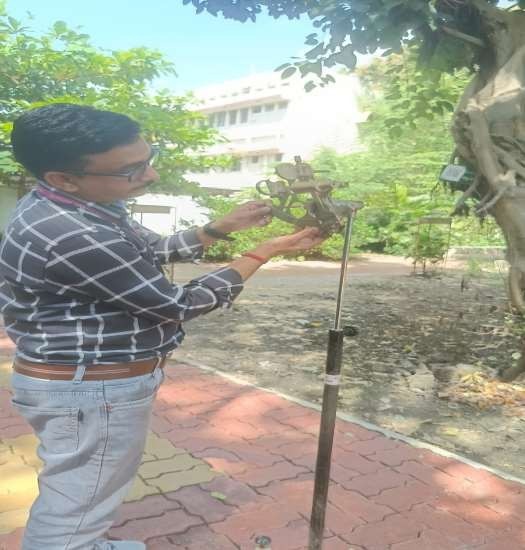 Prof V.D. Bute Sir guiding us about measuring height of the tree with the help of sextant. | 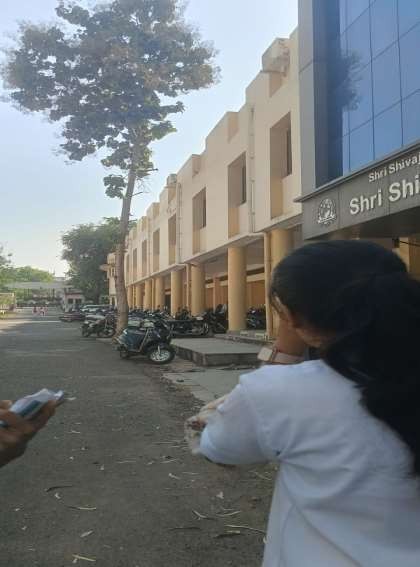 Measuring height of tree with the help of Sextant |
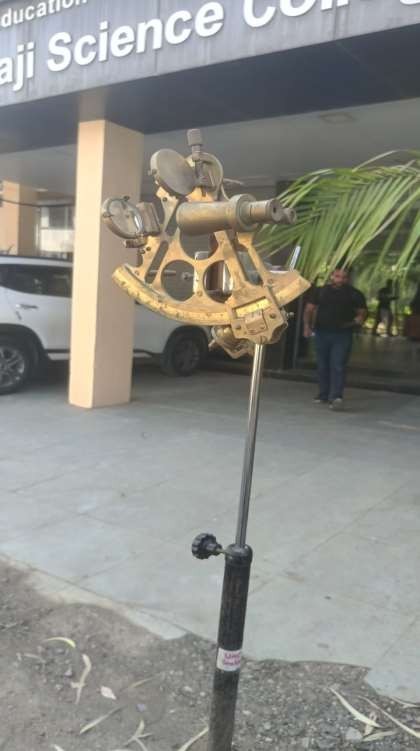 Instrument-Sextant |  blank |
 blank |  Blank |
Attendance Sheet: