SHRI SHIVAJI SCIENCE COLLEGE, AMRAVATI
DBT STAR COLLEGE PROJECT ACTIVITY
ACTIVITY REPORT
Guest Lecture on Malarial Parasite and Its Staining Techniques
Activity Dates: 22nd September 2025
Type of Activity: Other
Organizing Department: Department of Microbiology
Program Coordinators: Prof. Suwarna S. Mankar
Head of the Department: Dr. R. C. Maggirwar
External Collaborator (if any): NO
Objectives:
- To provide students with a comprehensive understanding of malaria as a parasitic disease and its global health significance.
- To introduce the causative organism Plasmodium and its different species affecting humans.
- To explain the life cycle of the malarial parasite, including both human and mosquito stages.
- To familiarize students with laboratory diagnostic methods used for malaria detection.
- To demonstrate the preparation of thick and thin blood smears for microscopic examination.
No of Beneficieries: 60
Classes Involved: B.Sc students
Venue of the Activity: Department of Microbiology, Shri Shivaji Science College, Amravati
Activity Report:
Report on Guest Lecture on Malarial Parasite and Its Staining Techniques
A guest lecture on the topic “Malarial Parasite and Its Staining Techniques” was successfully organized on 22nd September 2025 by the Department of Microbiology and Biotechnology for B.Sc. students. The primary objective of the lecture was to enhance students’ understanding of malaria, its causative organism, and the laboratory techniques used for its identification and diagnosis. Such academic initiatives are essential for bridging the gap between theoretical knowledge and practical application, thereby preparing students for future careers in microbiology and related fields.
The guest speaker for the session was Dr. Shilpa Lokhande, Assistant Professor in the PG Department of Microbiology at Sant Gadge Baba Amravati University. She is a distinguished academician and an expert in the field of medical microbiology, with specialization in microbiology and parasitology. Her vast knowledge, teaching experience, and practical expertise made the session highly informative and engaging. She effectively communicated complex scientific concepts in a simple and understandable manner, which greatly benefited the students.
The program commenced with a formal welcome by the faculty members, followed by the introduction of Dr. Lokhande. Her academic background, research contributions, and professional achievements were highlighted to acquaint students with her expertise. The warm welcome created a positive and enthusiastic environment, and students showed keen interest in the session right from the beginning.
Dr. Lokhande began her lecture by introducing malaria as a major parasitic disease caused by protozoa belonging to the genus Plasmodium. She explained its global significance, particularly in tropical and subtropical regions, and emphasized its impact on public health. She also discussed the prevalence of malaria in developing countries and the ongoing challenges in its control and eradication.
The lecture included a detailed explanation of the different species of Plasmodium that infect humans, namely Plasmodium falciparum, Plasmodium vivax, Plasmodium malariae, and Plasmodium ovale. She highlighted that Plasmodium falciparum is the most dangerous species, responsible for severe infections and higher mortality rates. The distinguishing characteristics, life cycle differences, and clinical manifestations associated with each species were clearly explained.
A significant portion of the lecture was dedicated to explaining the life cycle of the malarial parasite. Dr. Lokhande described its complex life cycle involving two hosts: humans and the female Anopheles mosquito. She elaborated on the asexual phase (schizogony) occurring in humans and the sexual phase (sporogony) in the mosquito. Various stages of the parasite, including sporozoites, merozoites, trophozoites, and gametocytes, were explained in a simplified manner with the help of diagrams and illustrations, making it easier for students to understand.
One of the most important aspects of the lecture was the focus on laboratory diagnosis of malaria, particularly staining techniques used for detecting the parasite in blood samples. The practical session was conducted at the Central Instrumentation Cell (CIC) of the college, where students were given hands-on exposure to laboratory procedures and equipment.
An important highlight of the session was the active involvement of Dr. Lokhande in demonstrating the techniques. Being an expert in medical microbiology, she personally brought the necessary laboratory materials, including slides and samples required for blood smear preparation. She conducted the demonstration in front of the students and guided them step-by-step in preparing both thick and thin blood smears. This hands-on approach allowed students to observe and learn the techniques directly under expert supervision, making the session highly interactive and practically enriching.
Dr. Lokhande emphasized that accurate laboratory diagnosis is essential for effective treatment and control of malaria. She explained that microscopic examination of stained blood smears remains the gold standard method for malaria diagnosis, especially in resource-limited settings.
She further explained the two primary types of blood smears used in malaria diagnosis. The thick smear is used for detecting the presence of parasites due to its higher sensitivity, as it concentrates blood components. On the other hand, the thin smear is used for identifying the species of Plasmodium based on morphological characteristics. She stressed the importance of proper smear preparation for obtaining accurate and reliable results.
The speaker provided a detailed explanation of staining techniques, particularly the use of Giemsa stain, which is widely used in parasitology. She described the procedure step-by-step, including collection of blood samples, preparation of smears on clean glass slides, air drying, fixation with methanol in the case of thin smears, staining with diluted Giemsa solution for a specific duration, washing with buffered water, drying, and finally observing under a microscope using oil immersion. She highlighted that proper staining is crucial as it enhances the visibility of parasite structures.
Dr. Lokhande also explained the morphological appearance of different stages of the parasite after staining. For instance, trophozoites appear as ring forms inside red blood cells, while schizonts and gametocytes show distinct characteristics depending on the species. She pointed out key identifying features such as chromatin dots, cytoplasmic appearance, size variations, and stippling patterns like Schüffner’s dots, which are useful in differentiating species.
In addition to Giemsa staining, she briefly discussed other staining techniques such as Leishman stain and Field stain. A comparison of these methods based on staining quality, time efficiency, ease of use, and suitability for field conditions was also provided, helping students understand their practical applications.
The lecture also covered the clinical aspects of malaria. Common symptoms such as fever, chills, sweating, headache, nausea, and anemia were discussed. She also explained severe complications including cerebral malaria, kidney failure, and respiratory distress. The importance of early diagnosis and timely treatment was strongly emphasized to prevent complications and reduce mortality.
Dr. Lokhande further elaborated on treatment and preventive measures. She discussed commonly used antimalarial drugs such as chloroquine and artemisinin-based combination therapies (ACTs), and highlighted the growing issue of drug resistance. Preventive strategies such as mosquito control, elimination of breeding sites, use of insecticide-treated bed nets, indoor residual spraying, and public awareness were emphasized as essential measures to control the spread of malaria.
The session was highly interactive, with students actively participating and asking questions related to staining techniques, parasite identification, and diagnostic challenges. Dr. Lokhande addressed all queries patiently and effectively, ensuring that students gained a clear understanding of the subject.
The lecture concluded with a vote of thanks delivered by a student representative, who expressed sincere gratitude to Dr. Lokhande for her valuable time, effort, and insightful presentation. Faculty members also appreciated her contribution in delivering such an informative and well-organized session. The program ended on a positive and motivating note.
Overall, the guest lecture proved to be highly beneficial for B.Sc. Microbiology students. It provided a comprehensive understanding of the malarial parasite along with practical knowledge of staining techniques used in its diagnosis. The session successfully integrated theoretical concepts with hands-on laboratory experience, thereby enhancing students’ academic learning and practical skills. It also inspired students to develop a deeper interest in parasitology and diagnostic microbiology.
The Department of Microbiology and Biotechnology looks forward to organizing more such guest lectures in the future, as they play a crucial role in enriching students’ knowledge and preparing them for future academic and professional endeavors in the field of science.
Outcomes:
- Students gained in-depth knowledge about malaria and its causative organism.
- Students were able to differentiate between various species of Plasmodium based on morphology and clinical features.
- Students understood the complete life cycle of the malarial parasite in both hosts.
- Students learned the importance of microscopic diagnosis and its role in effective treatment.
- Students acquired practical knowledge of preparing and staining blood smears.
Photos:
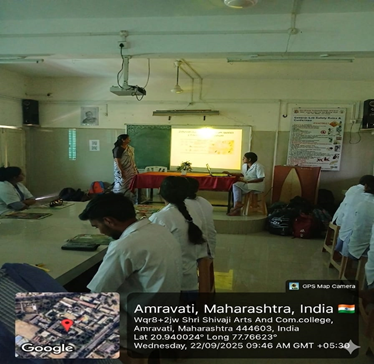 Guest lecture on “Malarial Parasite and Its Staining Techniques” in progress. | 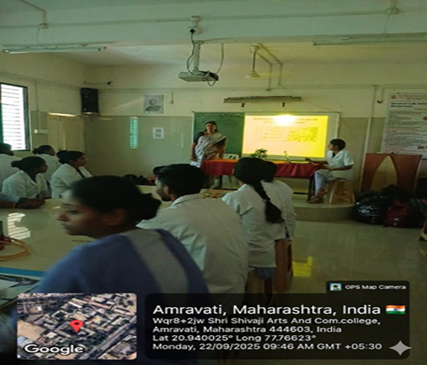 Dr. Shilpa Lokhande delivering an insightful lecture to B.Sc. students. |
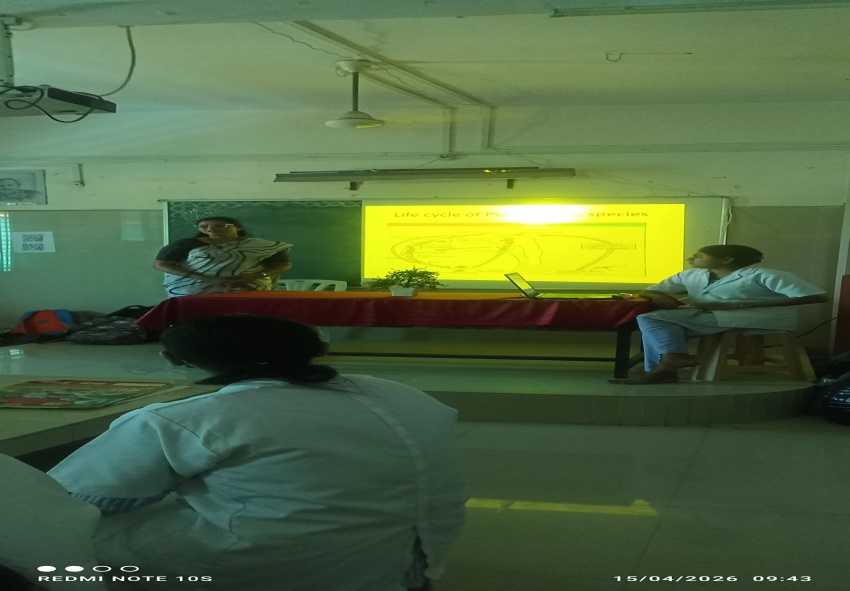 Students attentively participating in the guest lecture session. | 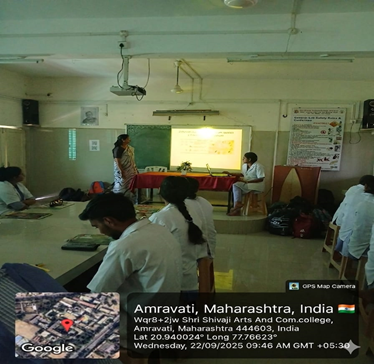 Interactive discussion between students and the guest speaker. |
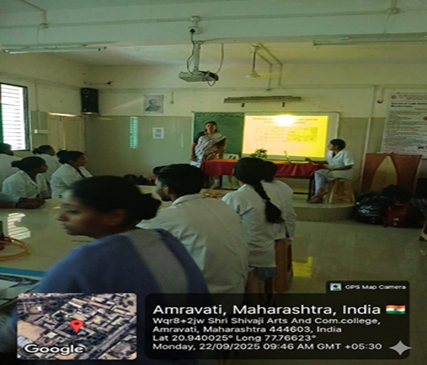 Explanation of the life cycle of the malarial parasite. | 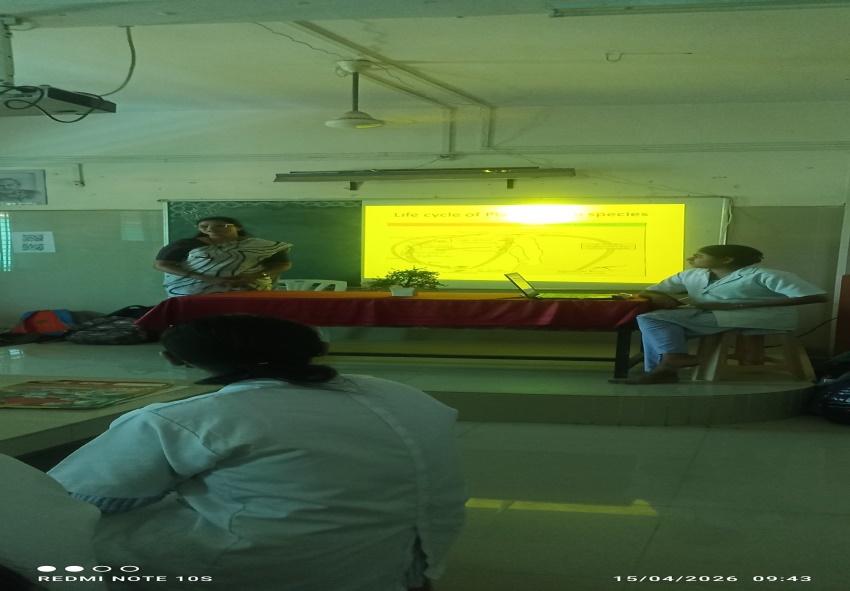 Detailed discussion on different species of Plasmodium. |
Attendance Sheet:
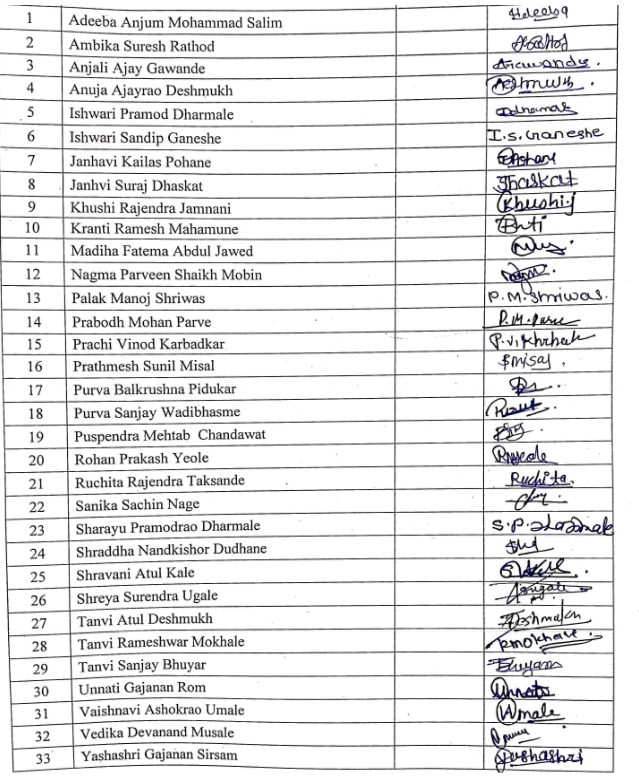 Sheet |